
Did you know that oral squamous cell carcinoma (OSCC)—a common type of oral cancer—affects hundreds of thousands of people globally each year?
Sadly, many cases are detected too late, making treatment more challenging and survival rates lower.
But what if we could catch it earlier, long before symptoms appear?
That’s where metabolomics, specifically salivary metabolomics, is a game-changer!
What is Metabolomics?
Metabolomics is the study of tiny molecules, called metabolites, that your body produces as it goes about its daily business—breaking down food, generating energy, and maintaining vital functions.
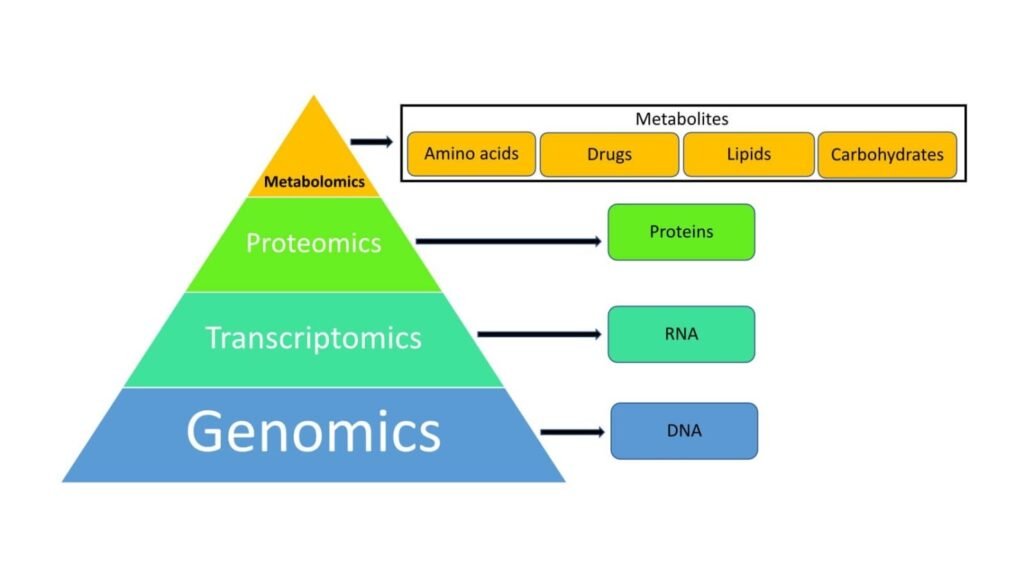
Picture credit: Emery Pharma
Think of it as decoding the chemical “language” your body uses to signal what’s happening inside.
Now, imagine applying this science to saliva. That’s salivary metabolomics—a cutting-edge approach that could make early detection of diseases like OSCC much simpler and less invasive.
Why Saliva for Oral Cancer?
It makes perfect sense: saliva is produced close to the areas where OSCC starts.
It’s also full of molecules directly linked to what’s happening in your body, including metabolites released by cancer cells.
This proximity and accessibility make saliva an ideal candidate for early cancer detection.
The Bigger Picture
Cancer cells don’t act like normal cells—they reprogram their metabolism to grow and divide rapidly. This reprogramming leaves behind a “molecular fingerprint” in saliva.
By analysing these changes, doctors could detect cancer before symptoms even appear!
Researchers are finding that certain metabolites in saliva act like red flags, signalling the presence of OSCC. These molecules reflect the altered metabolism of cancer cells.
The Key Metabolites to Watch
So, what does the science tell us so far?
Researchers have uncovered a treasure trove of potential biomarkers in saliva.
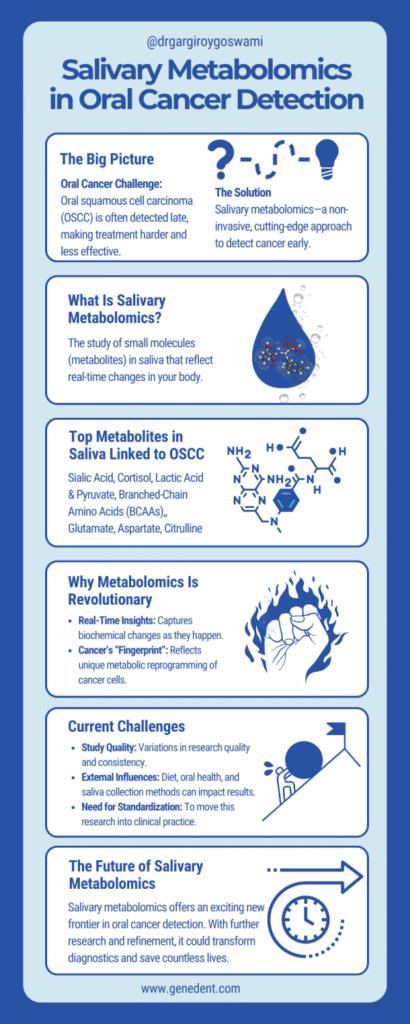
Here are some of the most promising ones:
- Sialic Acid: The most studied biomarker so far. It could help distinguish between healthy tissue and early cancer stages.
- Cortisol: Known as the “stress hormone,” it’s showing promise in identifying early-stage OSCC.
- Lactic Acid and Pyruvate: These molecules reflect the cancer cell’s “Warburg effect,” where cells shift their energy production to support rapid growth.
- Branched-chain amino Acids (BCAAs): These essential molecules fuel energy production and are linked to cancer growth.
- Other amino acids like glutamate, aspartate, and citrulline, which are key players in cell proliferation and differentiation.
Over 100 salivary metabolites have been linked to OSCC in research studies, which suggests a promising future for diagnostic tools.
Why Metabolomics is a Big Deal
Unlike traditional tests that might look at DNA or proteins, metabolomics provides a snapshot of the biochemical changes happening in real-time.
Cancer cells have a unique “metabolic fingerprint,” shaped by their altered pathways and energy demands.
Metabolomics captures these changes, offering a powerful new way to detect diseases like OSCC at the molecular level.
The Road Ahead: Challenges and Opportunities
While the idea of using salivary metabolomics to detect oral cancer is exciting, it’s still a work in progress. Some challenges remain:
- Study Quality: Many studies vary in quality, with only a few considered robust.
- Consistency: Factors like diet, oral health, and how saliva is collected can affect results, so standardizing procedures is critical.
- More Research Needed: For the transition from the lab to everyday clinical use, more well-designed studies are essential.
Having said that, the potential here is enormous!
Imagine a future where your dentist could collect a quick saliva sample and screen for oral cancer right in the office.
No needles, no pain—just a simple test that could save lives!
Wow!
Final Thoughts
Salivary metabolomics is one of the most exciting frontiers in cancer diagnostics.
By studying the small molecules in our saliva, scientists are identifying new ways to catch oral cancer early—when it’s most treatable.
While there’s still work to do, the progress is promising!
As research advances, it could be vital in transforming how we detect and treat oral cancer. Until then, regular check-ups and good oral hygiene remain your best defence.
Stay tuned—this is one area of science that’s worth keeping an eye on!
Post inspiration:
Rita Antonelli, Giacomo Setti, Nathaniel S. Treister, Thelma A. Pertinhez, Elena Ferrari, Mariana Gallo, Ronell Bologna-Molina, Paolo Vescovi, Marco Meleti. Salivary metabolomics in oral cancer: A systematic review, Oral Oncology Reports,Volume 11, 2024, 100657, ISSN 2772-9060,

