
Saliva, often underestimated in its complexity and importance, stands as a guardian of oral and general health.
Beyond its role in lubricating the oral cavity, saliva is a multifaceted fluid influencing microbial defence, food transport, buffering, and water balance.
The secrets it holds vary based on an intricate interplay of factors such as age, gender, diet, medications, and types of stimulation.
The Intricacies of Natural Saliva
Producing approximately 0.5–1 litre daily, natural saliva is a concoction of wonders!
The “whole saliva,” a clear, slightly acidic exocrine secretion, is contributed by diverse salivary glands.
Mucin, a heavyweight protein, is thought to bestow unique rheological and lubrication properties upon saliva.
Another player in the oral drama is the “saliva pellicle,” a supramolecular film on oral surfaces which contributes to the enigmatic world of oral lubrication.

Cryogenic-scanning electron micrographs(cryo-SEM) of human saliva at 80,000 magnification Source:DOI:10.1016/j.cis.2019.102034
In the realm of diagnostics, natural saliva emerges as a goldmine.
Advancements in research, propelled by quantitative techniques like chromatography and mass spectrometry, position saliva as a potential non-invasive diagnostic tool.
It serves as a reservoir of biological markers, allowing for the early detection of both oral and general diseases.
The Rise of Artificial Saliva: A Mimicry Attempt
Artificial saliva, popularly known as model saliva, is a commendable attempt to address the challenges posed by the collection and storage of real human saliva.
These formulations aim to replicate the ionic concentrations, pH, and viscosity of the natural counterpart.
However, the mimicry journey is not without its hurdles.
While artificial saliva, often enriched with pig gastric mucin (PGM) or bovine submaxillary mucin (BSM), succeeds in mirroring certain electrostatic and viscosity aspects, it falls short in capturing the elusive secrets of natural saliva.
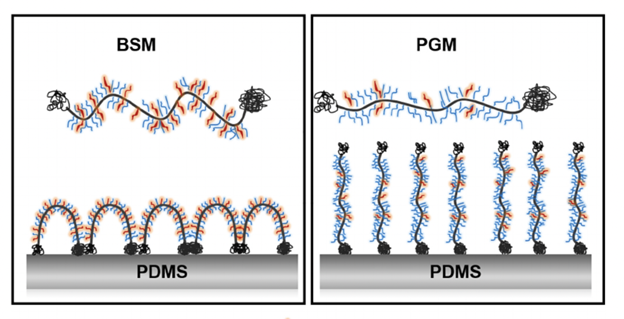
Schematic illustration of bovine submaxillary mucin (BSM),pig gastric mucin (PGM) Source: DOI:10.1016/j.cis.2019.102034
The limitations become apparent when it comes to replicating essential properties like lubrication and elasticity.
The oversight of salivary proteins beyond mucin proves to be a critical gap, as these proteins play a pivotal role in the nuanced colloidal interactions with food structures.
A Quest for Perfection: The Challenge of Mimicking Complexity
The pursuit of the perfect artificial saliva encounters challenges rooted in the intricate architecture of natural saliva.
The biochemical intricacies and multifunctionality of real saliva make the task of designing a standardized artificial version akin to solving a fascinating puzzle.
Yet, the insights gained from studies using model saliva contribute significantly to understanding the physicochemical mysteries, especially in the domain of sensory perception.
In this journey toward precision, bovine submaxillary mucin (BSM) emerges as a promising candidate for mimicking lubrication properties.
The call for further refinement and purifications of BSM echoes the quest for reproducibility and reliability in oral tribology experiments.
The Unfinished Tale: Mucin-Based Multilayers and Beyond
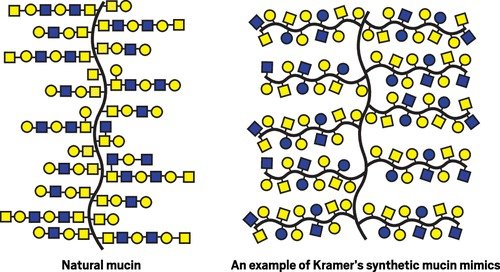
Credit: ACSCentralScience
As research plunges into the realms of mucin-based multilayers, the narrative of artificial saliva evolves.
Can these engineered layers truly replicate the complexity of the human salivary pellicle?
This question propels us into the heart of ongoing exploration.
The exploration from mimicking bulk properties to unravelling interfacial dynamics marks a significant stride in understanding the secrets of saliva, both natural and artificial.
Can artificial saliva truly capture the secrets of the mouth?
The answer remains an ongoing quest……
…a journey fueled by curiosity and a determination to decode the mysteries held within the fluid that not only lubricates our mouths but also holds the key to deeper insights into our health.
Post inspiration:
DO – 10.1016/j.cis.2019.102034
JO – Advances in Colloid and Interface Science
