
When you throw a pebble into a pond, ripples spread across the water long after the pebble is gone
Cancer leaves similar ripples inside the body…..
……not in water, but in our blood and even our saliva.
These ripples are called circulating tumour DNA (ctDNA), tiny fragments of genetic material shed by tumour cells as they grow, divide, and die.
And just like detectives following breadcrumbs, scientists have learned to collect and read these fragments to decipher cancer’s hidden story.
ctDNA: Cancer’s genetic breadcrumbs
Imagine a vase falling off your table and breaking into uncountable pieces.
Even when the vase is gone, the scattered pieces tell you its colour, shape, and design.
In the same way, when cancer cells die, they release DNA fragments into the bloodstream and saliva.
By piecing together these fragments, scientists can:
- Detect tumour-specific mutations
- Monitor if treatment is working
- Catch relapse early, sometimes before a scan shows anything
- Understand how the tumour is evolving over time
This is why ctDNA testing is called a liquid biopsy.
It’s a way of reading the tumour’s genetic diary without cutting into the tumour itself!
How fascinating! Isn’t it?
Blood-based ctDNA: A medical leap
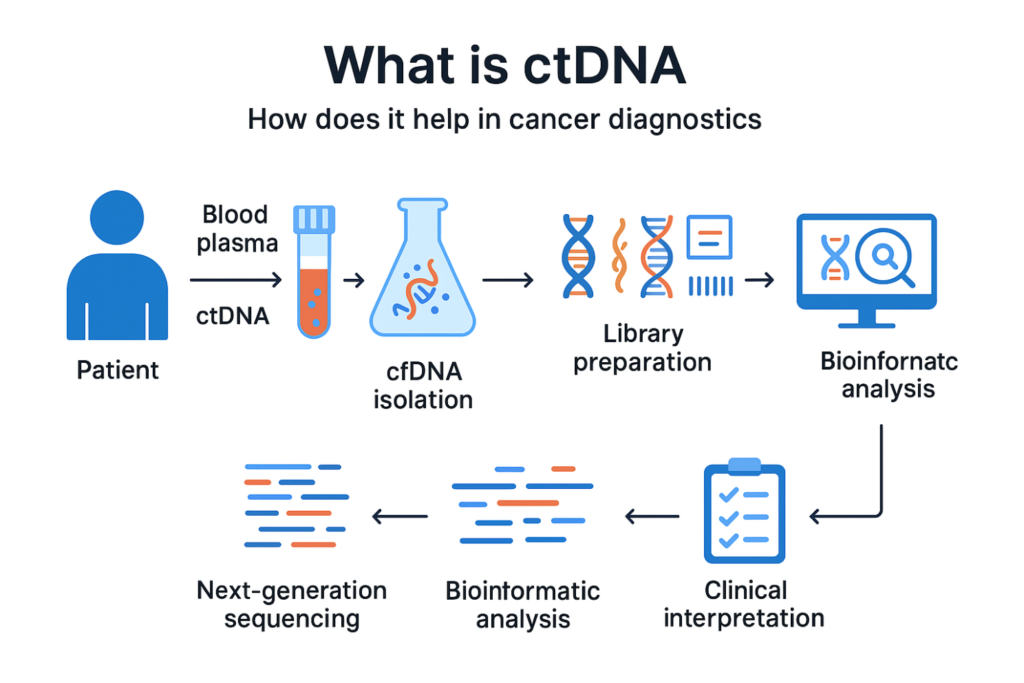
Today, most ctDNA tests are performed using blood.
Doctors draw plasma and isolate cell-free DNA (cfDNA), a mix of fragments from healthy and tumour cells.
Advanced sequencing then sorts through this soup of DNA, picking out the tumour-derived ones.
It’s a bit like finding a single red thread in a basket full of white yarn!
Sophisticated bioinformatics tools make that possible, giving clinicians a near real-time picture of what’s happening inside the patient’s body.
Blood-based ctDNA tests are already being used in certain cancers (like lung, colon, and breast cancers) to track therapy or spot resistance mutations.
What if your spit could help diagnose cancer?
Now here’s where things get fascinating: your saliva may be just as powerful, if not more, for detecting cancer.
At first, saliva sounds too ordinary, even messy, to be useful.
But remember:
Saliva is not just water. It’s a cocktail of DNA, proteins, microbes, and chemicals that reflect what’s happening in the entire body.
Think of saliva as the “fog” on your bathroom mirror after a shower. Invisible particles from your breath condense there, revealing what’s inside.
Similarly, saliva can carry genetic signals that mirror what’s happening deep within you.
International Saliva Summit of India (SALSI) 2026
Coming Soon!

Join SALSI LinkedIn Group:
https://www.linkedin.com/groups/13905994/
From Needles to… Spit?
Saliva may be the next frontier in ctDNA diagnostics.
Blood tests are like high-quality satellite images of a city, showing you what’s happening from above.
But saliva?
It is like walking through the streets and seeing the details up close.
Why saliva ctDNA matters:
- Non-invasive: No needles. Just spit in a tube.
- Frequent sampling and monitoring: Think of checking your health at home on a weekly basis without a clinic visit.
- Early detection: especially for head, neck, and some lung cancers.
- Accessibility: Saliva kits could democratise cancer screening, reaching areas where blood-based testing is difficult or unavailable.
The Bigger Picture
Imagine a future where:
- Instead of waiting months for scans, patients track their cancer weekly with a simple home saliva kit.
- People in rural or underserved areas access the same cutting-edge diagnostics as those in major cities.
- Cancer detection becomes as routine as cholesterol or glucose testing.
This is not just convenient; it could be life-saving!
Why this matters to all of us
ctDNA is more than a technology.
It is a shift in how we think about health.
Saliva, something we often dismiss as ordinary, could become one of the most powerful tools in oncology
A thought to leave you with….
The next time you spit after brushing your teeth, please pause for a moment.
Hidden in that swirl of bubbles and DNA fragments might lie the future of early cancer detection.
The question is:
Would you trust a saliva-based test if it could help catch cancer early?
Let’s start the conversation.

